Choosing an Igniter Charge for the I400
When the I400 fired on the test stand in September 2025, the start was not as clean as it could be. The motor came up to pressure 3 to 4 seconds after the igniter fired, and it got there in two steps: a chuff, a pause of about a second and a half, and only then the main burn. The motor and the hardware came through fine, but I would rather see it light in one go.
Before the next static test I wanted a better igniter. So this morning I tested four candidate charges.
What an igniter has to do#
RNX-71V is an epoxy-based propellant, and it is not as eager to light as sugar propellants or commercial APCP. The igniter has to put enough heat on the grain surfaces, for long enough, to get the whole core burning at once. A weak igniter warms only part of the surface, and the motor starts hesitantly, like the chuff and pause I saw in 2025.
There is also a limit on the other side. An igniter charge that burns too fast releases its gas in one go inside a closed motor. That pressure spike comes on top of the chamber pressure the motor builds as it lights. On a motor designed for about 70 bar (1000 psi), an unnecessary spike at ignition is not something I want.
So the charge should be hot and last a little while, without being explosive.
The test setup#
I compared two pyrotechnic mixtures, each at two charge weights:
- ZnS, zinc and sulphur. A classic, fast-burning mixture.
- CuO-Al, copper thermite: copper oxide and aluminium. It burns at a very high temperature and makes very little gas; the reaction product is molten copper.
Each charge went into an Eppendorf cup, held in place with wadding, with a commercial electric igniter as the initiator. The cup was taped to the top of a fence post and fired remotely using my remote launch controller . The charges were 2 g and 3 g (0.07 and 0.11 oz).
This is an open-air test, so it only shows how each charge burns, not how it behaves inside the motor. It is still a cheap way to throw out the bad candidates before using a propellant load on them.
2 g ZnS: lit, but with a pop#
The 2 g ZnS charge ignited reliably, but it went off with a brisk pop. In the open air that is just a noise. Inside the motor, that pop means a fast pressure rise, and that is the overpressure at ignition I want to avoid. It also burns out quickly, so the time it spends heating the propellant is short.
3 g ZnS: a misfire#
The 3 g ZnS charge fizzled and misfired. More of the same mixture did worse than less, which makes ZnS unpredictable in this setup on top of the pop. That was the end of ZnS for this motor.
2 g and 3 g CuO-Al thermite: a spray of molten metal#
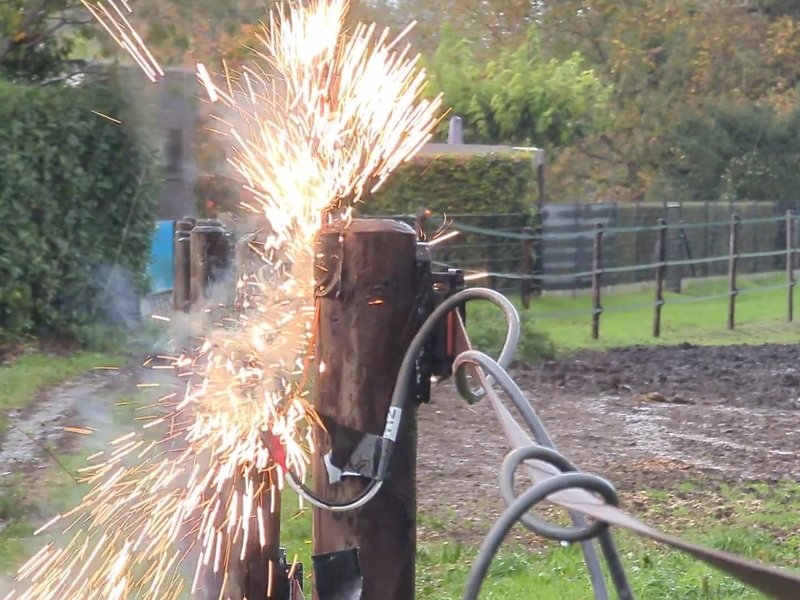
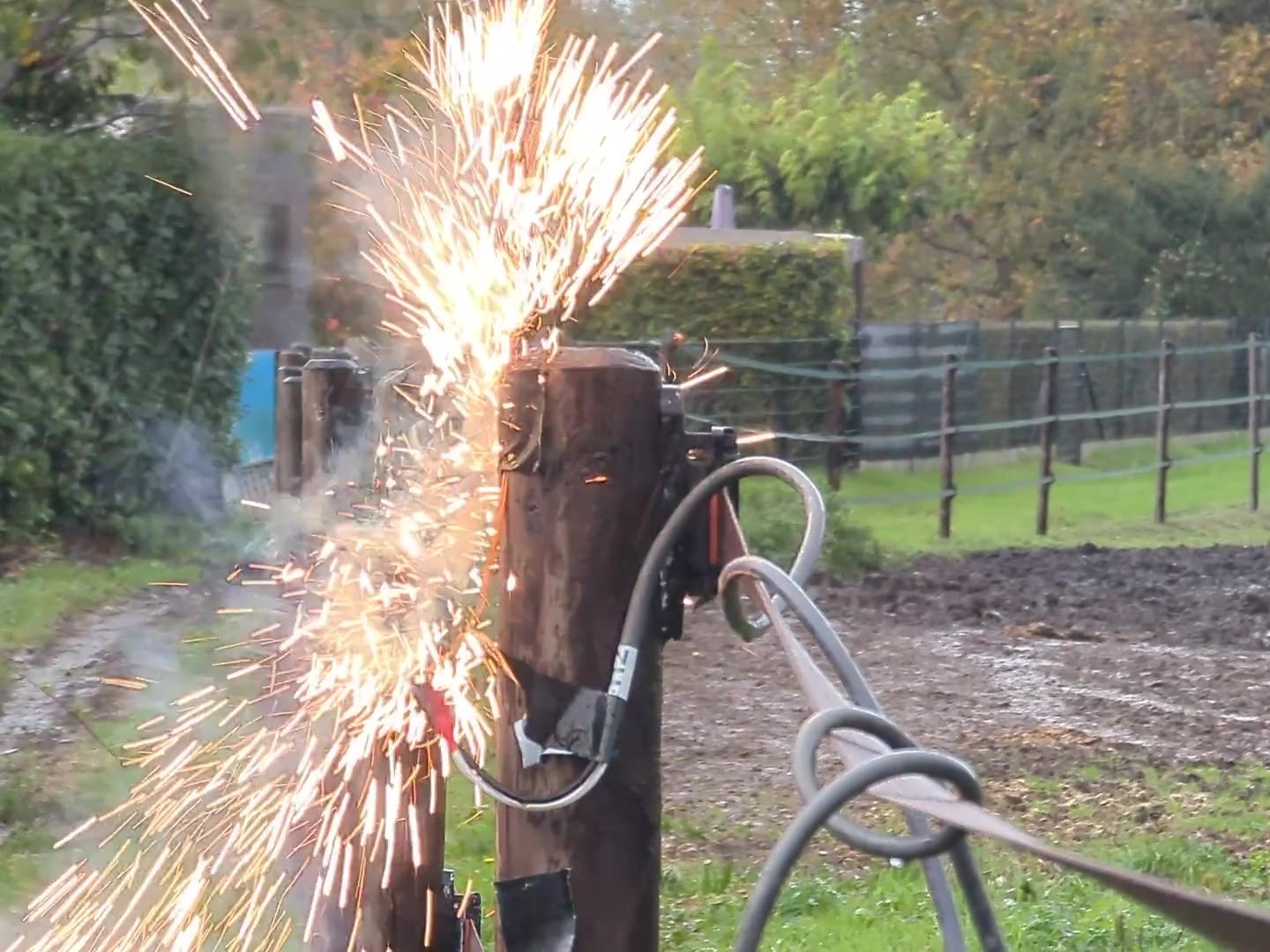
Both thermite charges ignited well, with a good spray of molten metal particles and no pop. That is exactly the behaviour I was after. The droplets of molten metal carry a lot of heat, and inside the motor they land on the propellant surfaces and stick there, heating the grain locally until it lights, instead of the heat leaving with the gas through the nozzle. And because thermite makes so little gas, it adds almost nothing to the pressure in the chamber at the moment of ignition.
The plan for the next static test#
CuO-Al thermite is the winner. For the next static test of the I400 I will start with 2 g of CuO-Al. If the motor doesn’t come up to pressure immediately, the next test gets 3 g.
The pressure transducer on the test stand will show how well it works: a clean start shows up as a quick, smooth rise to chamber pressure right after the igniter pulse, without the chuff and the pause from the last test.
Resources#
- The I400: Designing and Testing an I-Class Rocket Motor , the motor and its first static test
- Measuring a Rocket Motor with an NI USB-6009 , the data logger that fires the igniter and records the test
- Richard Nakka’s Experimental Rocketry Web Site , which has a section on igniters for amateur motors